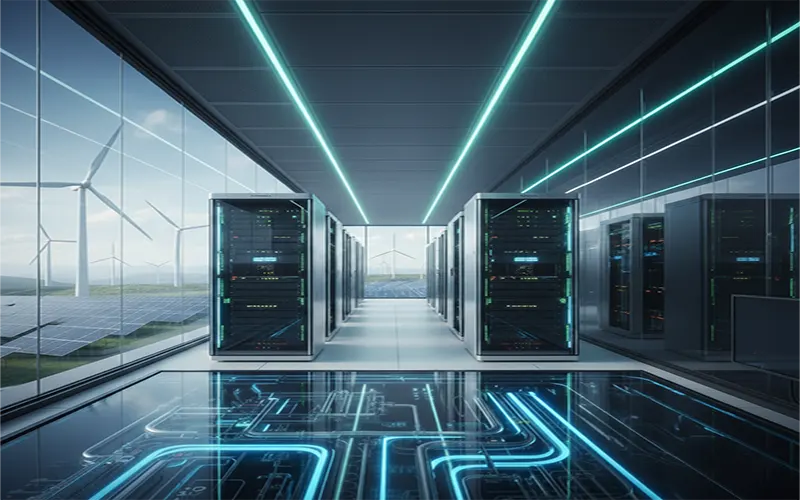
As we navigate through 2026, the digital economy is facing a reckoning. The explosion of AI-driven compute and the ever-expanding global web have pushed the energy consumption of data centers to unprecedented heights. For years, “Green Web Hosting” was largely a marketing term supported by the purchase of cheap carbon offsets—a practice now widely criticized as insufficient. Today, the standard for true sustainability has shifted toward physical infrastructure efficiency and real-time renewable energy matching. At the heart of this revolution is the quest for a Power Usage Effectiveness (PUE) of 1.2.
Decoding PUE 1.2: The Physics of Efficiency
To understand why a 1.2 rating is the “gold standard” for 2026, we must first look at the metric itself. Power Usage Effectiveness is the industry-standard ratio used to determine how efficiently a data center uses energy. It is expressed by the formula:
$$PUE = \frac{\text{Total Facility Power}}{\text{IT Equipment Power}}$$
In this equation, the “Total Facility Power” includes everything: lighting, cooling, power distribution losses, and the servers themselves. An ideal PUE is 1.0, which would mean every single watt pulled from the grid goes directly into a processor.
Historically, the industry average has hovered between 1.6 and 1.8, meaning for every watt used to power a server, nearly another watt was wasted on cooling and infrastructure. A PUE of 1.2 signifies that only 20% of the energy is used for non-computing overhead. Achieving this in 2026 requires a radical departure from traditional “raised floor” air conditioning. Modern 1.2 facilities utilize:
- Immersion Cooling: Submerging server components in specialized dielectric fluids that conduct heat 1,200 times more efficiently than air.
- AI-Driven Thermal Management: Machine learning algorithms that adjust fan speeds and coolant flow in real-time based on micro-fluctuations in server load.
- Waste Heat Recovery: Instead of venting heat into the atmosphere, PUE 1.2 facilities often pipe excess thermal energy into local district heating systems or industrial processes.
Beyond Offsets: The 24/7 Renewable Energy Reality
For a long time, web hosts claimed to be “100% Green” by purchasing Renewable Energy Certificates (RECs). However, this created a temporal mismatch: a data center might consume coal-powered energy at night but “offset” it with wind energy produced during a storm three months prior.
In 2026, the focus has shifted to 24/7 Carbon-Free Energy (CFE). This means the hosting provider ensures that every kilowatt-hour of electricity consumed is matched, hour-for-hour, by carbon-free energy produced on the same local grid.
The Role of On-site Generation and BESS
To hit these targets, green hosts are becoming power producers. By integrating Direct On-site Generation (typically massive solar arrays or hydrogen fuel cells) with Battery Energy Storage Systems (BESS), data centers can “load shift.” They store excess renewable energy during peak production hours and discharge it when the sun sets, ensuring the servers never touch “dirty” grid power.
Furthermore, these facilities are now Grid-Interactive. Using smart inverters, they can actually feed power back into the local community during grid stress, transforming the data center from a passive energy drain into a stabilizing ecological asset.
The Performance Benefit: Green is Fast
A common misconception is that “Eco-friendly” means “Lower Performance.” In 2026, the opposite is true. The drive for lower PUE has forced hardware innovation that directly benefits the end-user.
- ARM-Based Architecture: High-efficiency hosts have transitioned to custom ARM-based processors (like the latest Graviton or Ampere iterations). These chips provide higher thread density and better throughput than legacy x86 architectures while consuming 60% less power. For the customer, this translates to faster page loads and lower latency at a more competitive price point.
- Edge Proximity: Because PUE 1.2 facilities (especially those using liquid cooling) are quieter and require smaller footprints, they can be located in urban centers closer to the users. This reduces the “network distance” data must travel, significantly improving the Core Web Vitals for hosted applications.
Comparison: The Green Evolution
| Feature | Old School Green (2015-2022) | Modern Green Hosting (2026) |
| Primary Metric | Carbon Offsets / RECs | PUE 1.2 + WUE |
| Cooling Method | CRAC (Air Conditioning) | Immersion / Cold Plate Liquid |
| Energy Matching | Annual / Monthly Average | Hourly Carbon Matching (24/7) |
| Hardware | Legacy x86 Servers | Energy-Efficient ARM / RISC-V |
| Transparency | Marketing Badges | Real-time API Sustainability Dashboards |
What to Look for in a 2026 Green Provider
If you are a CTO or developer looking to migrate to a high-efficiency host, you must look past the “green leaf” logos. Demand transparency in the following areas:
- Real-time PUE Reporting: A reputable host should provide a public or customer-facing dashboard showing their instantaneous PUE. If it’s consistently above 1.3, they aren’t using modern cooling.
- Water Usage Effectiveness (WUE): High-efficiency cooling shouldn’t come at the cost of local water supplies. Look for providers using “closed-loop” systems that have a WUE near zero.
- Scope 3 Emission Transparency: Truly green hosts track the “embodied carbon” of the servers themselves—the emissions created during the mining and manufacturing of the hardware.
The Future of the Ecological Data Center
The internet is the largest machine ever built by humanity, and its thirst for energy is only growing. However, the move toward PUE 1.2 and 24/7 renewable matching proves that digital growth doesn’t have to come at the expense of the planet. By choosing a host that prioritizes mechanical efficiency and carbon-free energy, businesses are doing more than just “reducing harm.” They are supporting a new infrastructure paradigm where the data center acts as a responsible participant in the global ecosystem—a cool, quiet, and carbon-free engine for the next generation of the web.