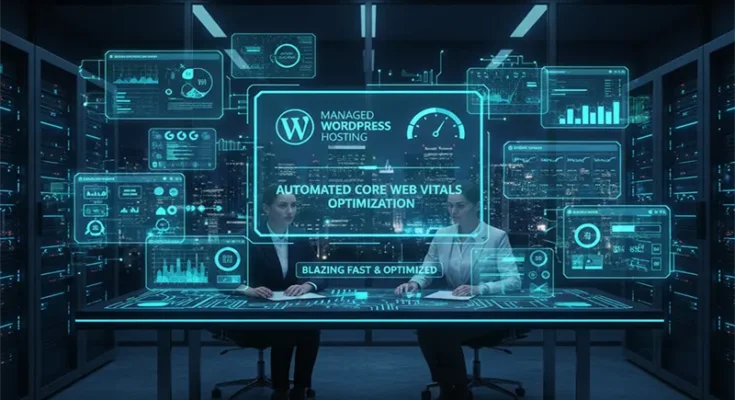
Managed WordPress Hosting with Automated Core Web Vitals Optimization

Managed WordPress Hosting with Automated Core Web Vitals Optimization

In 2026, the digital landscape has shifted from manual performance tuning to Zero-Touch Optimization. For WordPress site owners, the “Conversion Gap”—the difference in revenue between a fast and slow site—is wider than ever. As Google’s algorithms have matured, Core Web Vitals (CWV) have transitioned from a specialized SEO project to a foundational requirement of managed hosting.

The industry benchmark in 2026 is no longer just about loading speed; it’s about responsiveness. With the replacement of First Input Delay (FID) by Interaction to Next Paint (INP) as a primary ranking factor, hosting providers have had to re-engineer their stacks to prioritize main-thread availability and nearly instantaneous visual feedback.

1. The Anatomy of Automated CWV

Modern managed hosts now treat CWV optimization as a server-level service rather than a plugin-based task. Here is how the three pillars of Core Web Vitals are handled automatically in 2026.


Largest Contentful Paint (LCP):

Managed WordPress Hosting with Automated Core Web Vitals Optimization Read More
Node.js Backend Hosting with Real-Time WebSocket Support

Node.js Backend Hosting with Real-Time WebSocket Support

In the digital landscape of 2026, real-time connectivity is no longer a “luxury feature”—it is the baseline for modern user experiences. Whether it’s a high-frequency trading platform, a collaborative 3D design tool, or an AI-powered live support agent, the underlying technology remains the same: WebSockets.

However, hosting a Node.js backend with WebSocket support in 2026 introduces a unique set of challenges. Unlike traditional REST APIs, which are stateless and short-lived, WebSockets are stateful and persistent. They require a server to hold an open “pipe” for every single user, often for hours at a time. This “Stateful Challenge” means that scaling a real-time app isn’t just about adding more RAM; it’s about architecting for concurrency.

Choosing Your Engine: ws vs. Socket.io in 2026

While Node.js v22+ finally introduced a stable, built-in WebSocket client (via the Undici library), the server-side implementation still requires specialized libraries. In 2026, the industry has …

Node.js Backend Hosting with Real-Time WebSocket Support Read More
Secure HIPAA-Compliant Cloud Hosting for Healthcare Apps

Secure HIPAA-Compliant Cloud Hosting for Healthcare Apps

In 2026, healthcare data has become the primary target for sophisticated, AI-driven cyberattacks. With the global average cost of a healthcare data breach climbing to a staggering $10.93 million, the “cost of doing business” now includes a mandatory investment in a resilient, high-security infrastructure. Compliance is no longer just a legal hurdle; it is a critical component of patient safety and business continuity.

The regulatory environment has also tightened. As of February 16, 2026, all covered entities must have updated their Notice of Privacy Practices (NPP) to account for new protections regarding substance use disorder (SUD) records. Failure to align your hosting environment with these updated privacy and security rules can lead to severe federal penalties and irreversible reputational damage.

The BAA: Your Legal and Operational Foundation

Under HIPAA, any cloud service provider that touches Electronic Protected Health Information (ePHI) is considered a “Business Associate.” You cannot legally …

Secure HIPAA-Compliant Cloud Hosting for Healthcare Apps Read More
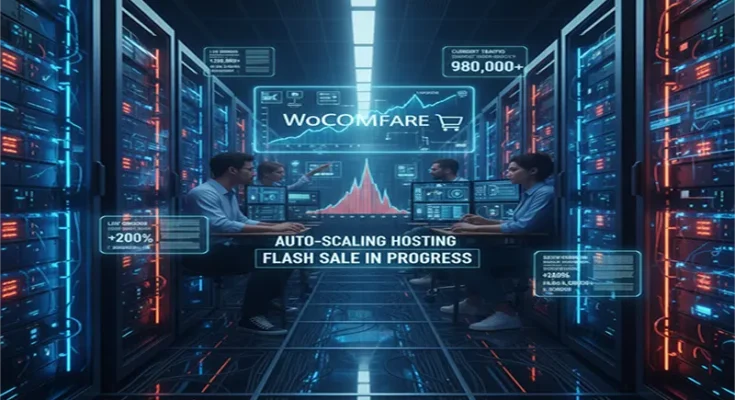
Auto-scaling WooCommerce Hosting for High-Traffic Flash Sales

Auto-scaling WooCommerce Hosting for High-Traffic Flash Sales

The “Flash Sale” is the ultimate stress test for any e-commerce platform. For WooCommerce store owners in 2026, the challenge is no longer just about having a “fast” website—it’s about handling Inference Economics and Concurrency at an industrial scale. When an influencer drops a link or a Black Friday timer hits zero, a store can go from 10 users to 10,000 in seconds. On standard managed hosting, this results in the dreaded “502 Bad Gateway” as PHP workers saturate and the database enters a deadlock.

To survive these spikes, your architecture must transition from a single-server setup to a modern, containerized auto-scaling environment. By leveraging WooCommerce 9.x features like High-Performance Order Storage (HPOS) and stateless infrastructure, you can ensure your checkout remains fluid while your competitors’ sites are crashing.

The Architecture of Auto-scaling: Horizontal vs. Vertical

When traffic spikes, you have two ways to scale. Vertical Scaling (scaling up) involves …

Auto-scaling WooCommerce Hosting for High-Traffic Flash Sales Read More
High-Efficiency PUE 1.2 Green Web Hosting Powered by Renewable Energy

High-Efficiency PUE 1.2 Green Web Hosting Powered by Renewable Energy

As we navigate through 2026, the digital economy is facing a reckoning. The explosion of AI-driven compute and the ever-expanding global web have pushed the energy consumption of data centers to unprecedented heights. For years, “Green Web Hosting” was largely a marketing term supported by the purchase of cheap carbon offsets—a practice now widely criticized as insufficient. Today, the standard for true sustainability has shifted toward physical infrastructure efficiency and real-time renewable energy matching. At the heart of this revolution is the quest for a Power Usage Effectiveness (PUE) of 1.2.

Decoding PUE 1.2: The Physics of Efficiency

To understand why a 1.2 rating is the “gold standard” for 2026, we must first look at the metric itself. Power Usage Effectiveness is the industry-standard ratio used to determine how efficiently a data center uses energy. It is expressed by the formula:

$$PUE = \frac{\text{Total Facility Power}}{\text{IT Equipment Power}}$$

In …

High-Efficiency PUE 1.2 Green Web Hosting Powered by Renewable Energy Read More