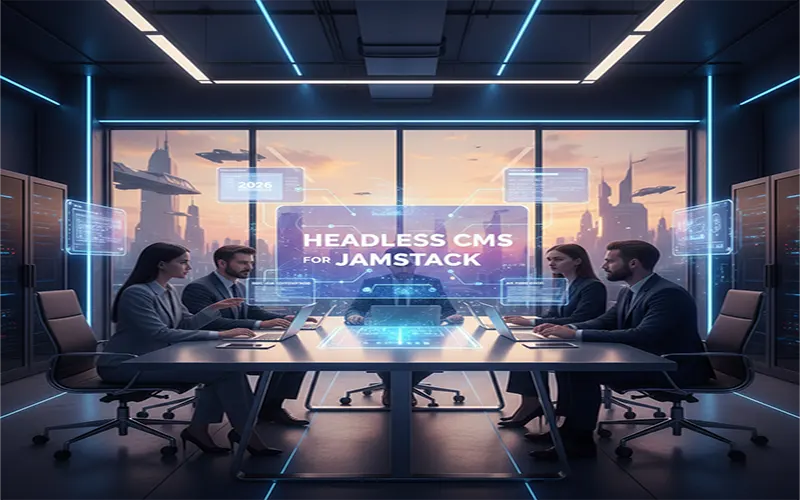
The Jamstack has undergone a fundamental transformation in 2026. What began as a movement for simple static sites has matured into a sophisticated architecture of Dynamic Edge Orchestration. Today, we no longer talk about “decoupling” in a vacuum; we talk about Composable Content Platforms that act as the cognitive center of a high-performance web presence.
As frameworks like Next.js 16, Astro 5.0, and React 19 have standardized React Server Components (RSC) and edge-native rendering, the role of the Headless CMS has shifted. It is no longer just a place to store text; it is an orchestration layer for AI-generated content, localized assets, and federated data sources.
The 2026 Leaderboard: Top 4 Platforms
In 2026, four platforms have emerged as the dominant players, each solving a unique friction point in the modern developer’s workflow.
1. Sanity: The Content Operating System
Sanity has officially moved beyond the “Headless CMS” label, branding itself as a Content Operating System. Its core strength remains the Content Lake, a real-time graph-relational database.
- Why it wins in 2026: Sanity’s new AI orchestration layer allows developers to trigger “Agent Actions” on content changes. For example, updating a product description can automatically trigger an AI agent to generate SEO metadata, translate the text into six languages, and update related social media assets—all within the Sanity Studio.
- Developer Experience: Its TypeScript-first approach and the flexibility of GROQ (Graph-Relational Object Queries) make it the preferred choice for complex, data-heavy applications.
2. Storyblok: The Visual Jamstack Pioneer
For years, the biggest complaint about Jamstack was the lack of a “What You See Is What You Get” (WYSIWYG) experience for marketers. Storyblok solved this with its market-leading Visual Editor.
- Why it wins in 2026: Storyblok’s “Slices” (reusable components) are now more powerful than ever. In 2026, marketers can drag and drop components that are 1:1 reflections of React/Astro components, seeing real-time previews powered by Next.js Draft Mode.
- Best For: Marketing-driven teams that need to build complex layouts without touching code.
3. Hygraph: The Master of Content Federation
As architectures grow, content often sits in silos (e.g., product data in Shopify, marketing text in a CMS, and user data in an external CRM). Hygraph treats this as a feature, not a bug, through Content Federation.
- Why it wins in 2026: Hygraph allows you to unify multiple APIs into a single, high-performance GraphQL endpoint. You can “stitch” external data sources directly into your CMS schema, making it the “single source of truth” without actually migrating the data.
- Best For: Enterprise-level Jamstack sites that require high data integrity across multiple legacy and modern systems.
4. Strapi: The Open-Source Powerhouse
Strapi remains the king of the self-hosted ecosystem, though its Strapi Cloud managed service has seen massive adoption in 2026 for teams that want the power of open-source without the DevOps headache.
- Why it wins in 2026: Strapi 5.x introduced a revolutionary plugin marketplace that is now almost entirely AI-driven. From automated content audits to “Vibe Coding” integrations for code-gen, Strapi offers a level of customization that SaaS platforms struggle to match.
- Best For: Teams that require full ownership of their data and infrastructure (Privacy-first or FinTech sectors).
2026 Headless CMS Comparison Table
| Platform | API Style | Best For | 2026 Pricing (Starting) |
| Sanity | GROQ / GraphQL | Data-heavy Apps & AI Workflows | Free / $15 per user |
| Storyblok | REST / GraphQL | Visual Editing & Marketing Sites | Free / $9 per user |
| Hygraph | GraphQL (Native) | Content Federation & Omnichannel | Free / $299 (Scale Plan) |
| Strapi | REST / GraphQL | Self-hosting & Custom Plugins | $0 (Community) / $15 (Cloud) |
Selection Criteria for the Modern Stack
When evaluating a CMS in 2026, look beyond the price tag. Focus on these three technical pillars:
- API Latency & Edge Caching: In 2026, a 200ms API response is considered slow. Your CMS must support Edge-side caching so that content is served from a CDN node as close to the user as possible.
- AI-Native Workflow: Does the CMS have built-in hooks for LLMs? Look for features like Vector Search support and automated tagging, which significantly reduce the manual labor for content teams.
- Visual Composability: If your marketing team can’t see what they are building, they will inevitably ask to move back to a monolith like WordPress. Ensure the CMS supports real-time visual previews.
The “Git-based vs. API-based” Debate: 2026 Edition
The debate between Git-based (where content is stored in Markdown files in your repo) and API-based (where content is in a database) has evolved.
- Git-based (TinaCMS, Decap): These are still excellent for developer-only projects or documentation sites. They offer perfect version control and allow developers to stay in their IDE. TinaCMS is the leader here, offering a visual editing layer on top of Markdown files.
- API-based (Sanity, Hygraph): These are the standard for 90% of professional Jamstack projects. They handle large media assets better, offer more granular permissions, and provide the “real-time” collaboration features that large organizations require.
Choosing Your Path
The “Best” CMS in 2026 is the one that empowers both your developers and your editors.
- For high-growth Startups: Start with Sanity or Storyblok. They offer the fastest route to a “Pro” feel with minimal infrastructure setup.
- For Complex Enterprises: Invest in Hygraph. The ability to federate your data will save you thousands of hours in migration costs over the next five years.
- For the Privacy-Conscious: Stick with Strapi. The control you gain over your data residency and server environment is invaluable.
As we look toward 2027, the trend toward Autonomous Content—where the CMS proactively suggests layout changes based on user performance data—is already beginning. Choosing a platform that is “AI-ready” today is the best way to future-proof your Jamstack site for tomorrow.