
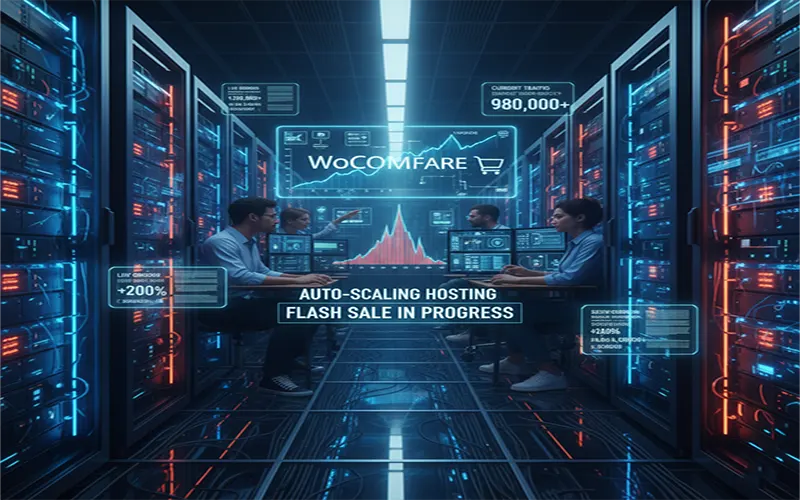
The “Flash Sale” is the ultimate stress test for any e-commerce platform. For WooCommerce store owners in 2026, the challenge is no longer just about having a “fast” website—it’s about handling Inference Economics and Concurrency at an industrial scale. When an influencer drops a link or a Black Friday timer hits zero, a store can go from 10 users to 10,000 in seconds. On standard managed hosting, this results in the dreaded “502 Bad Gateway” as PHP workers saturate and the database enters a deadlock.
To survive these spikes, your architecture must transition from a single-server setup to a modern, containerized auto-scaling environment. By leveraging WooCommerce 9.x features like High-Performance Order Storage (HPOS) and stateless infrastructure, you can ensure your checkout remains fluid while your competitors’ sites are crashing.
The Architecture of Auto-scaling: Horizontal vs. Vertical
When traffic spikes, you have two ways to scale. Vertical Scaling (scaling up) involves adding more CPU and RAM to a single machine. While simple, it has a “ceiling” and often requires a reboot—the last thing you want during a sale.
Horizontal Scaling (scaling out) is the 2026 standard for enterprise WooCommerce. Instead of one giant server, you use a Load Balancer to distribute traffic across a “fleet” of smaller, identical web nodes.
- Statelessness: For horizontal scaling to work, your web nodes must be “stateless.” This means user images, sessions, and site files cannot live on the server itself. They must be offloaded to centralized storage (like Amazon S3 for media) and a centralized session handler (Redis).
- Elasticity: An auto-scaling group monitors your PHP Worker usage. When 80% of workers are busy, the system automatically spins up three new server nodes in under 60 seconds to absorb the load.
Solving the Database Bottleneck: The “Checkout Crunch”
In a flash sale, the bottleneck isn’t usually the homepage; it’s the database during the checkout process. Every “Add to Cart” and “Place Order” action is a “Write” operation that cannot be cached.
1. High-Performance Order Storage (HPOS)
In 2026, HPOS is mandatory. By moving order data out of the generic wp_posts and wp_postmeta tables into dedicated, indexed SQL tables, WooCommerce can process checkouts up to 5x faster. This significantly reduces “Lock Contention,” where multiple users are trying to update the same database table at once.
2. Database Read Replicas
For massive sales, use a primary database for “Writes” (orders) and multiple Read Replicas for “Reads” (product descriptions, inventory checks). This prevents the checkout process from being slowed down by thousands of people simply browsing the catalog.
3. Redis Object Caching
Moving your site’s “Object Cache” to a dedicated Redis cluster is non-negotiable. This prevents the database from being hit for repetitive queries, such as fetching site settings or user metadata, freeing up the SQL engine to focus purely on processing transactions.
The Edge Layer: Full-Page Caching at Scale
The best way to handle 10,000 users is to ensure 9,000 of them never even reach your server.
In 2026, Edge Caching (via Cloudflare Enterprise or Akamai) allows you to store your entire product catalog at data centers geographically close to your users. The “magic” lies in the Bypass Cache on Cookie logic. Static visitors see a lightning-fast cached version of your site, while the moment a user adds an item to their cart, a cookie is set that tells the Edge to “pass through” to the auto-scaling origin for the checkout journey.
Top 2026 Providers for Auto-scaling WooCommerce
If you aren’t managing your own Kubernetes cluster, these providers offer the best proprietary auto-scaling logic:
- Nexcess (Liquid Web): Known for its “Cloud Accelerator” and dedicated auto-scaling that doesn’t charge per-visit overages during spikes. It is specifically tuned for the WooCommerce database schema.
- Kinsta: Utilizes Google Cloud’s C3D machines and isolated container technology. Their infrastructure auto-scales PHP workers dynamically, ensuring your site has the “burst” capacity needed for influencer-driven traffic.
- WP Engine: Their Mercury Platform is built specifically for high-concurrency WooCommerce. It uses proprietary “EverCache” for aggressive caching and offers a high-performance database cluster for enterprise-grade sales.
Pre-Sale Technical Checklist
Before your sale goes live, ensure these boxes are checked:
- HPOS Enabled: Confirm you have migrated to High-Performance Order Storage.
- PHP 8.3/8.4: Ensure you are running the latest version for improved execution speed.
- Load Testing: Run a simulated test using tools like k6 or Loader.io to see where your site breaks.
- Redis Check: Verify that Object Cache Pro is active and connected to a dedicated Redis instance.
- Image Optimization: Use a CDN to serve AVIF/WebP images so your web nodes aren’t wasting bandwidth on heavy assets.
- Deactivate “Heavy” Plugins: Turn off non-essential plugins (like robust reporting or backup tools) during the sale window to save PHP Workers.
Success in a 2026 flash sale is a matter of architectural preparation. By decoupling your database, offloading sessions to Redis, and utilizing a horizontally auto-scaling host, you transform WooCommerce from a simple plugin into an enterprise-grade commerce engine. Remember: in a flash sale, every millisecond of latency is a lost conversion. Build for scale, or prepare for the fail.