In 2026, the strategic calculation for a startup’s mobile presence has fundamentally changed. We are no longer in the era where “Native is the only way to feel like an app.” The technological gap that once separated the mobile web from the App Store has been bridged by WebAssembly (Wasm), enhanced Service Worker capabilities, and—most crucially—Apple’s comprehensive adoption of open web standards for iOS.
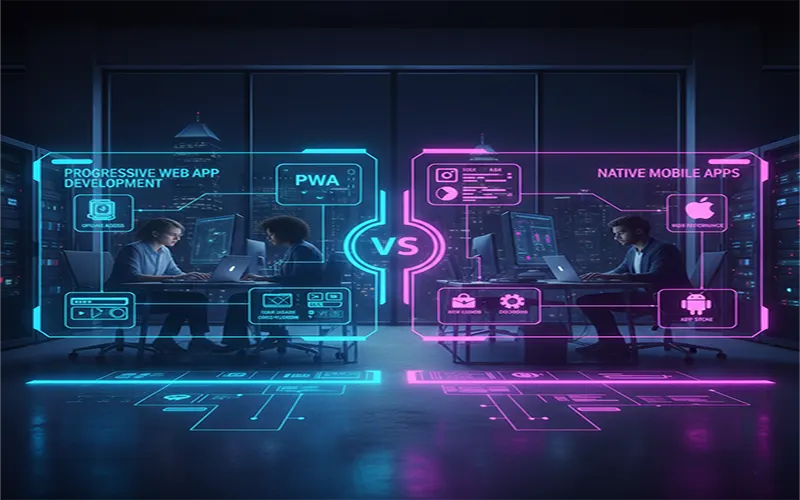
For a startup founder, the decision between a Progressive Web App (PWA) and a Native Mobile App is no longer just a technical choice; it is a financial and distribution strategy that can determine your “runway” and your “Time to Product-Market Fit.”
The “App Store Barrier” and the 2026 Shift
Historically, startups flocked to Native apps because they wanted two things: Push Notifications and a presence on the user’s Home Screen. For a decade, Apple restricted these features to Native apps only.
However, as of 2026, the “App Store Barrier” has eroded. Users are increasingly suffering from “App Fatigue”—a reluctance to download yet another 100MB utility from a store that requires a password, a face scan, and a five-minute wait. PWAs allow startups to offer an “instant-on” experience. A user clicks a link from an Instagram ad or a Google search result, and within two seconds, they are inside a fully functional, installable app without ever leaving their browser.
The PWA Case: Friction-less Distribution and Speed to Market
1. Bypassing the “Gatekeepers”
One of the most significant advantages of a PWA in 2026 is the avoidance of the App Store approval cycle. Native apps are subject to the whims of reviewers and the strict “Apple Tax”—a 15–30% cut of all digital goods. PWAs allow you to own your customer relationship and your revenue 100%.
2. The SEO Advantage (Discoverability)
Native apps live in a “walled garden.” Their content isn’t easily indexed by search engines. In contrast, every page of your PWA is a URL. This means your app’s content can rank on Google, bringing in organic traffic that native apps simply cannot access. In an era where Customer Acquisition Cost (CAC) is skyrocketing, Organic Search Discoverability is a startup’s best friend.
3. Unified Codebase & Lower Burn Rate
In 2026, a startup can build a single PWA using React 19 or Astro 5.0 that serves desktop users, Android users, and iOS users simultaneously.
Startup Tip: Building a PWA typically costs 40-60% less than maintaining separate Swift (iOS) and Kotlin (Android) teams. For a Seed-stage company, that extra capital often translates to six more months of runway.
The Native Case: The Performance Ceiling and UX Fidelity
Despite the rise of the web, Native apps remain the choice for “Premium” or “Hardware-Intensive” experiences. If your startup’s core value proposition relies on the following, Native is still your path:
- Deep Hardware Integration: While PWAs can now access the camera and GPS, they still struggle with low-level Bluetooth (BLE), advanced LiDAR/AR processing, and background geolocation (essential for fitness trackers or complex delivery apps).
- High-Performance Gaming & AI: For GPU-heavy tasks, Native code still beats the browser. While WebAssembly has improved Wasm-based performance by 400% since 2023, high-end mobile games and real-time video editing suites still perform better when “closer to the metal.”
- Biometric Security: While web-based Passkeys are now standard, the seamless “FaceID to pay” experience in a native app still feels more integrated and trustworthy for FinTech and Healthcare users.
The 2026 Decision Matrix
| Metric | Progressive Web App (PWA) | Native Mobile App |
| Development Cost | Low (Single codebase) | High (Two+ codebases) |
| Time to Market | Instant (Deploy to URL) | Slow (App Store Review) |
| User Acquisition | Low Friction (Click-to-open) | High Friction (Store download) |
| Push Notifications | Full Support (iOS & Android) | Full Support (Native) |
| Offline Power | Strong (via Service Workers) | Total (Offline-first) |
| Apple/Google Tax | 0% | 15% – 30% |
The “Third Way”: Cross-Platform Frameworks
If you feel you must be in the App Store but can’t afford two teams, 2026 sees Flutter and React Native at their peak. These frameworks allow you to write one codebase that compiles into native binaries.
- Pros: Access to App Store discovery and native APIs.
- Cons: You are still subject to the “Apple Tax” and the friction of the download process.
The “Web-First” Strategy
The consensus for startups in 2026 has shifted toward the “PWA-First, Native-Later” approach.
Build your MVP as a high-performance PWA. This allows you to iterate daily, acquire users through SEO and social media with zero friction, and keep 100% of your revenue. Once you have found Product-Market Fit and your users are asking for deeper hardware integration—or once your brand is strong enough that users will seek you out in the App Store—only then should you invest the $100k+ required for a truly “Native” experience.